CHRISTIAN SEMANTICS
----TOPIC LIST----
In the summer of 2018 I experienced a personal impact event. I did some computer searches following the “Test” and “Do not add” instructions of Bible passages:
1 Thess 5:21
21 But test and prove all things [until you can recognize] what is good; [to that] hold fast. AMP
21 Test everything. Hold on to the good. NIV
and
Prov 30:5-6
5 Every word of God is flawless;
he is a shield to those who take refuge in him.
6 Do not add to his words[emphasis mine],
or he will rebuke you and prove you a liar. NIV
Word search
I looked for several common words and phrases used by Bible scholars, clergy and laymen. Having grown up as a Southern Baptist and having received a Master of Divinity degree from a Southern Baptist Seminary, I was amazed and startled by what I discovered. As the searches unfolded, at age 78, two realizations were profound to me.
1) These words or phrases are not in the English translations as one would expect after hearing expositors or reading commentaries.
2) The scholars whose assignment was to translate the Bible from another language into English...the translators...did not include the words or phrases. But they are commonly used in exposition and commentary. Why? One wonders and suspects the exposition and commentary have stepped out of bounds.
|
Question: In the following table, does the phrase/word show up in the English translation? |
||||||||||||||
|
→Phrase/word→ |
out of nothing |
from nothing |
infallible |
inerrant |
without error |
errorless |
is everywhere |
|||||||
|
↓Translation↓ |
Y |
N |
Y |
N |
Y |
N |
Y |
N |
Y |
N |
Y |
N |
Y |
N |
|
New International Version |
√ |
√ |
√ |
√ |
√ |
√ |
√ |
|||||||
|
New American Standard Bible |
√ |
√ |
√ |
√ |
√ |
√ |
√ |
|||||||
|
King James Version |
√ |
√ |
** |
√ |
√ |
√ |
√ |
|||||||
|
New King James Version |
√ |
√ |
** |
√ |
√ |
√ |
√ |
|||||||
|
American Standard Version |
√ |
√ |
√ |
√ |
√ |
√ |
√ |
|||||||
|
Amplified Bible |
√ |
√ |
** |
√ |
√ |
√ |
*** |
|||||||
|
Bible in Basic English |
√ |
√ |
√ |
√ |
√ |
√ |
√ |
|||||||
|
Contemporary English Version |
√ |
√ |
√ |
√ |
√ |
√ |
*** |
|||||||
|
Holman Christian Standard Bible |
√ |
√ |
√ |
√ |
√ |
√ |
√ |
|||||||
|
Easy to Read Version |
√ |
* |
√ |
√ |
√ |
√ |
√ |
|||||||
|
Ths Living Bible |
√ |
√ |
√ |
√ |
√ |
√ |
√ |
|||||||
|
Complete Jewish Bible |
√ |
√ |
√ |
√ |
√ |
√ |
√ |
|||||||
* - Prov 30:30 Easy-to-Read Version, a lion—he is the warrior of the animals and runs from nothing, * -"nothing" NIV, 229 times in OT, 113 in NT, zero before Gen 11:6
** - Acts 1:3 KJV and similar in NKJV To whom also he shewed himself alive after his passion by many infallible proofs, being seen of them forty days, and speaking of the things pertaining to the kingdom of God
***-Jer 2:35 [that is everywhere evident.] AMP… Acts 28:22 is everywhere denounced. AMP… Isa 59:14 Injustice is everywhere CEV…Hos 4:2 Violence is everywhere CEV
"in an instant" is up to eight times in the Bible, zero in Genesis
"instantly" twice in NT related to healing, zero in Genesis
All of the words or phrases deserve and need to be “tested”.
Out of nothing
The first phrase I searched for was “out of nothing”. I first searched the New International Version (NIV). The phrase is not there at all, zero times it occurs…in the entire Bible. I searched eleven other English translations. Zero.
“Out of nothing” could be added to Genesis 1:1 in multiple ways (Keep in mind the “Do not add” instruction in Proverbs 30:6.):
Out of nothing, in the beginning God…
In the beginning, out of nothing, God…
In the beginning God, out of nothing…
In the beginning God created, out of nothing…
In the beginning God created the heavens and the earth, out of nothing.
Did the translators of the dozen versions not know what they were doing? Or were they simply obeying the “Do not add” instruction? Didn’t God choose to reveal himself in the Bible? Why did the Holy Spirit not inspire the profound words “created out of nothing”, but did inspire:
Matt 10:30-31
And even the very hairs of your head are all numbered. NIV?
“Numbered hairs” seems like absolute trivia to me, compared to the magnitude of the phrase “created out of nothing”. But the Holy Spirit deemed it important that we be told our hairs are numbered…and not be told that creation was “out of nothing”??!! Why would the Holy Spirit leave that out? Could it be that it is not true? English translations do not include the words “out of nothing”. So why is the “out of nothing” claim made when scripture clearly says “do not add”, seriously warning against it? To be careful one must ask if the scriptures somehow indicate creation was “out of nothing”.
I submit the thought that “out of nothing” has been added by well-intended folk… perhaps thinking that is what the Bible should have said, or that it is a proper interpretation of what the Bible does say. However, what if the translators are correct and “out of nothing” is an improper addition to scripture?
I further submit that “out of nothing” dishonors God. It presents a diminished view of God. A creator “out of nothing” is a fantasy being, commonly called a genie, which magically zaps into existence whatever some wisher wants. It does not use intelligence to plan or design or create. It just zaps. It needs no plan or design, which requires intelligence. God is not the ultimate genie. He is not a genie at all. He possesses boundless intelligence and He uses it…as He plans and designs and creates what He plans and designs. What if it was God who inspired the statement “Nothing ever came from nothing”?
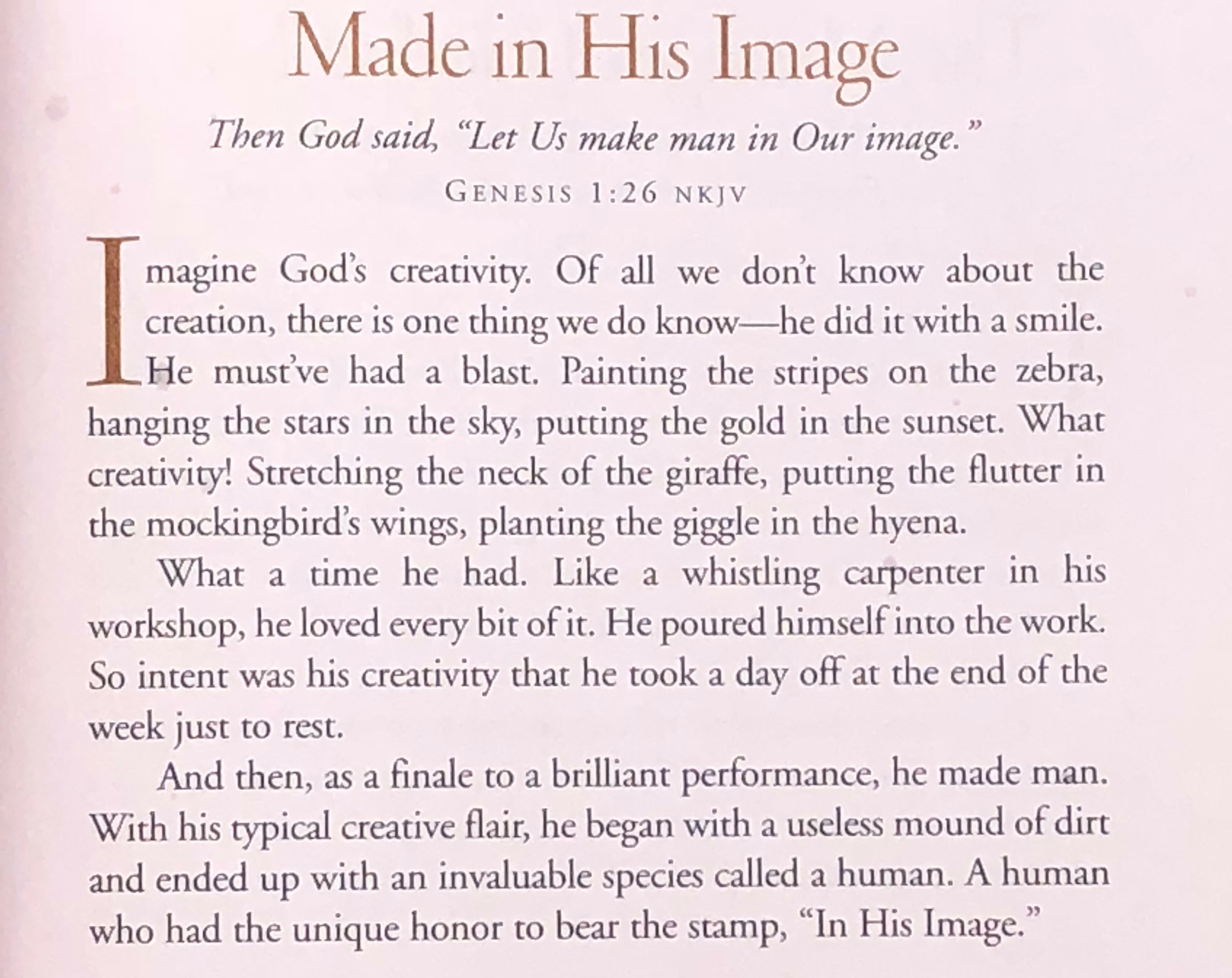
Furthermore, I submit that “out of nothing” robs God. It robs Him of the thought conveyed in Psalms 19:5…”like a champion rejoicing to run his course”. I say that from my perspective as an electrical engineer. I have been blessed many times personally with the great pleasure, satisfaction and sense of fulfillment of arriving at a concept and, through design and construction, successfully bringing it into reality. I don’t mean pride here, but simple, pure pleasure and satisfaction of accomplishment, of finishing well, of seeing that it was/is good. In every case it took time and intellectual effort, one project spanning years. The satisfaction is not only in the finished product. The process itself is laced with exhilarating fun, the fun of designing. The idea of zapping into existence “out of nothing” robs God of that…especially in light of the fact that we are created in the image of God. Does that not mean that God has traits that we have? Does that not include getting pleasure and satisfaction out of designing and creating?
Max Lucado in his devotional book GRACE FOR THE MOMENT, April 11, Evening (published by Thomas Nelson), conveys a sense of what I am trying to say:
The following verse has been presented as supporting evidence that “out of nothing” is a correct interpretation of Genesis 1:1.
Heb 11:3
3 By faith we understand that the universe was formed at God's command, so that what is seen was not made out of what was visible. NIV
The words “formed” and “made” (begun, done and finished) do not mean nor imply “zapped” (immediate). But the sentence clearly indicates that “what is seen was”… “made out of what was invisible". There are a wide variety of gases that are “something” invisible. Energy is invisible. Could it be that God took a little pinch of his boundless energy and transformed it into the stuff of our universe? That assertion does not violate scripture. To examine the thought consider what energy is. It is the undefined unknown that must be present for anything to be done, to take place. And it must be present in the amount necessary for accomplishment of what is done. Scientists do not claim to know what energy is. It is commonly called the capacity or ability to do work. It is called “capacity” because with it we can do something. Without it we can do nothing, no breathing, eating, thinking…nothing. Energy exists in various forms: heat, light, electricity, etc. Scientists have learned that, whatever energy is, it can be quantified, i.e., measured. Energy is the “E” in Einstein’s famous equation E=MC2.
God, being eternal and almighty has always had boundless energy, or the supernatural equivalent to natural energy. God and God’s energy are not the same. Energy was/is what he possesses and uses to do what he does. He has eternally possessed it. He does with it whatever he chooses.
Scientists in the twentieth century demonstrated conclusively that the matter in the universe is made of energy, or contains energy. Search the internet for the “largest bomb”. Watch the videos that show the effect of the energy in matter being released in nuclear explosions. A few pounds of matter contain enormous amounts of energy. How was all that energy bound up in the matter? Where did it come from?
This begs the question “If God created the universe out of energy, why doesn’t Genesis 1:1 read ’In the beginning God created, out of energy…’”? It seems to me that God purposely omitted the words “out of”. Perhaps discovering the “out of” was part of all the learning necessary to subdue the earth, which God commanded in Genesis 1:28, “…fill the earth and subdue it”. If “out of” had been included in Genesis 1:1, it would have distracted from the huge point…God did it. He created.
A full description of all the details of the creation event would have been a meaningless revelation in Moses’ day. The vocabulary was not available. No one could have understood it. The task of writing it would have been too much. There would have been no way to keep all the scrolls needed. Only a few could have been read. God had Moses write what we needed to know in outline form, truths that we must know. What Moses wrote was understandable then, and it remains so now. We are still learning, discovering, the full story…still subduing the earth.
The Bible does not say that God created “out of nothing”. Nor does it say “out of energy”. The word “nothing” appears 342 times in the New International Version (NIV). It seems to always mean…nothing…the opposite of something. “Nothing” is not in the creation narrative. The first use of "nothing" in the NIV is in Genesis 11. The word “energy” appears just one time in the NIV. Whatever it is, energy is something, not nothing.
Col 1:29
To this end I labor, struggling with all his energy, which so powerfully works in me. NIV
The Amplified Bible says it this way:
Col 1:29
For this I labor [unto weariness], striving with all the superhuman energy which He so mightily enkindles and works within me. AMP
The message is that God is applying and activating in Paul that which God possesses, namely God's energy. To repeat, scientists have conclusively demonstrated that the elements in the universe embody gigantic portions of energy. The same word is used by scientists and NIV and AMP translators, energy. Other Bible translators use the word “power” or “working” or “strength”, all of which involve expended energy. “Energeian” is the Greek word in Col 1:29.
Speaking of God, Romans 11:36 (NIV) says, "For from him and through him and for him are all things." Allow me to add a bracketed interpretation, "For from him [his energy] and through him [his creating] and for him [the Devine Being] are all things." That appears to be a valid interpretation to me. We do not meet to worship God's "energy" or "creating". Those are just a couple of many reasons we worship HIM.
So, where are we at this point? It is clear that the Bible does not say “out of nothing”. Nor does it say “out of energy”. The Bible does not teach “out of nothing”. Nor does it teach “out of energy”. To add either to the creation narrative would be to violate the “do not add” command in Proverbs. One would be well advised to not declare or proclaim either. To do so would be adding. If one is to speak about it at all, the wise choice would be “I think” or “I believe” or “It seems” or “It appears”. In that vein it appears to me that “out of nothing” is wrong and “out of energy” might be true.
Furthermore, referring to the creation event the scripture says that God worked for six days, the opposite of zapping. The words “let there be” can be said many times in just a few seconds.
Gen 2:2-3
By the seventh day God had finished the work he had been doing; so on the seventh day he rested from all his work. 3 And God blessed the seventh day and made it holy, because on it he rested from all the work of creating that he had done. NIV
“Work” appears three times in that passage. Doesn’t this add credence to the “out of energy” thinking?
It also appears to me that “out of nothing” is a stumbling block to unbelieving scientists and/or lay people who are aware that matter contains such huge amounts of energy. Pure, accurate analysis of complete, pure, accurate scientific data will never be wrong. After all, it is a study of God’s creation. It will never be in conflict with scripture. Problems occur when human scientists and others use bad or incomplete data to arrive at false conclusions and erroneously report that “science says”.
Concluding this discussion, I ask what authority allows anyone to finish the phrase “out of…” when speaking of God's creation. The Bible does not finish it. And we should not argue about it.
2 Tim 2:14
Warn them before God against quarreling about words; it is of no value, and only ruins those who listen. NIV
“Do not add…”, out of nothing. It obscures, or detracts from, the simple and profound "In the beginning God created..."
Is everywhere
The Bible never says God is everywhere. Why should he even want to be everywhere? Doesn’t everywhere include infinite space with infinite x,y,z coordinates? Why should God want to be everywhere in an infinite expanse of apparent nothing. The Bible definitely does teach that no human can go where God is not. If one of his children goes somewhere, Goes arrives with the child. Or he goes ahead because the child is coming. He is wherever he wants to be, when he wants to be there.
Ps 139:7-10
Where can I go from your Spirit?
Where can I flee from your presence?
8 If I go up to the heavens, you are there;
if I make my bed in the depths, you are there.
9 If I rise on the wings of the dawn,
if I settle on the far side of the sea,
10 even there your hand will guide me,
your right hand will hold me fast. NIV
Prov 15:3
The eyes of the LORD are everywhere, keeping watch on the wicked and the good. NIV
He is looking where there is wicked and good. He knows where that is...not everywhere. Semantics!
Fully God and fully man
The glass drawn below is full to the brim with liquid. Common English vernacular would not say the liquid is "fully water and fully oil". "Fully" implies "full" or "completely" or "altogether". It could be properly said that the oil is genuine and possesses all the atributes of oil, and the water is genuine water and contains all the attributes of water...but not "fully water and fully oil". Furthermore, no automobile is fully steel, or fully plastic, or fully both.
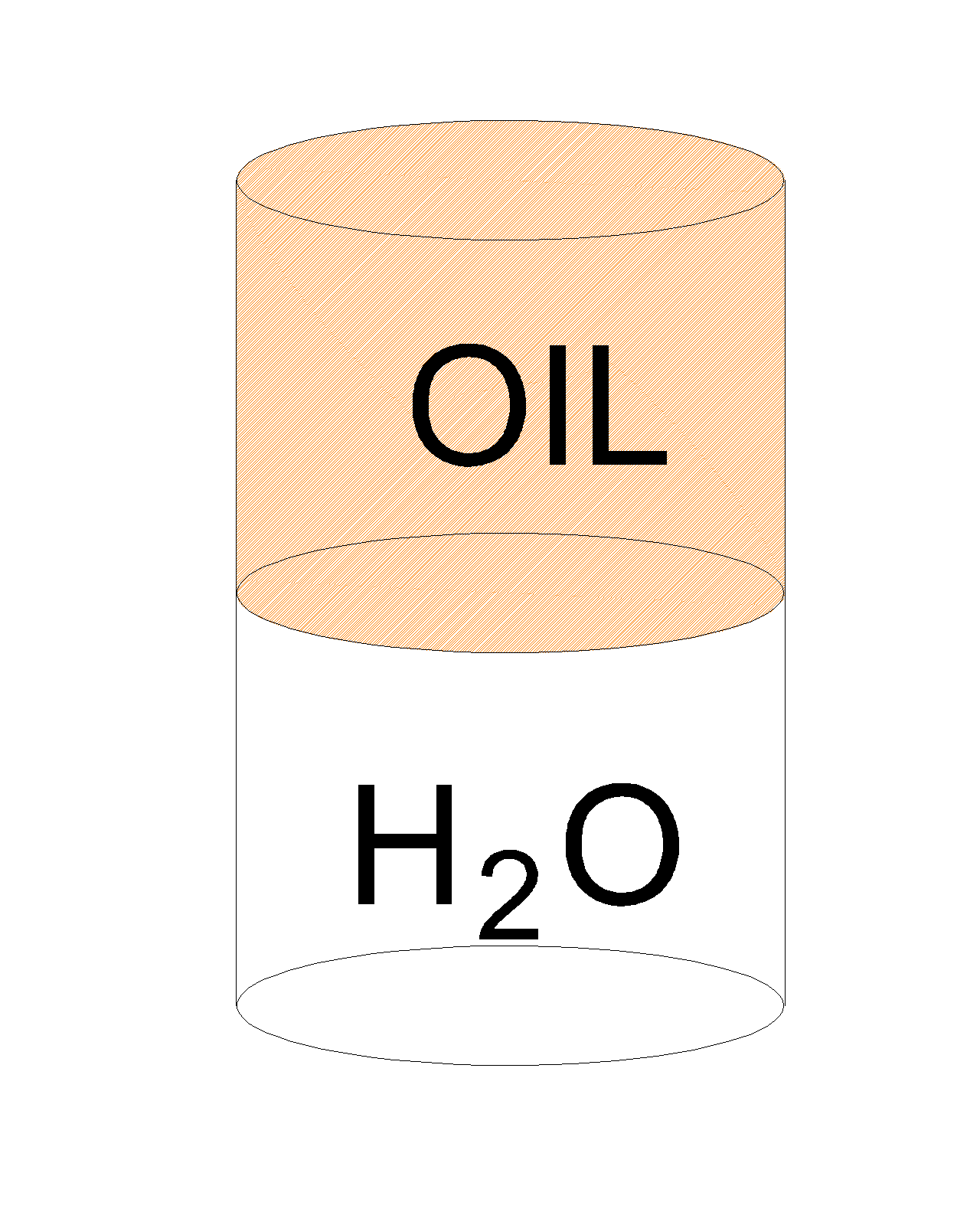
Nearly a century ago the Southern Baptist Faith and Message was edited to include the claim that Jesus was/is “fully God and fully man”. Neither of those terms are in the English Bible translations, together nor separately. So why are they used currently at all? The Holy Spirit did not inspire any original language words or wording that should be translated “fully God and fully man”. Or the translators failed in their assignment.
Philippians 2:6-8
Who, being in the very nature of God, did not consider equality with God something to be used to his own advantage, rather, he made himself nothing taking the very nature of a servant, being made in human likeness. And being found in appearance as a man, he humbled himself by becoming obedient to death---even death on a cross.
"he made himself nothing ", i.e., less than fully God.
Luke 2:52
And Jesus grew in wisdom and stature and in favor with God and a man.
"grew in wisdom"...if he was fully God he already had it all...no growing in wisdom.
Matt 28:18
Then Jesus came to them and said. “all authority in heaven and on earth has been given to me...”
"has been given to me"...prior to that time he was not fully God.
Heb 2:9
But we do see Jesus, who was made lower than the Angels for a little while.
"lower than the Angels" is not fully God.
Every human needs a Savior, to understand that Jesus was/is God in the flesh, Emanuel…and trust him. Did Jesus need a savior? Certainly not. Without that need how can it be said that he was/is fully human...like we are? It would have been exceedingly simple for the Holy Spirit to inspire wording in the original documents that would translate to English “fully God and fully man”, if it was actually true and if we need to know it. The Holy Spirit did not.
Infallible, inerrant, without error, errorless
None of these words occur in the English translations (except the single use of "infallible" in Acts 1:3, KJV). They apply to the Bible because 2nd Peter 1:20, 21 is in the Bible.
2 Peter 1:20-21
20 Above all, you must understand that no prophecy of Scripture came about by the prophet's own interpretation. 21 For prophecy never had its origin in the will of man, but men spoke from God as they were carried along by the Holy Spirit. NIV
These verses proclaim that we cannot interpret the Scripture without the guidance of the Holy Spirit. And they validate the terms infallible, inerrant, without error, errorless. They also proclaim that the Scripture must be interpreted. So what did Jesus mean when he said:
Matt 5:18
I tell you the truth, until heaven and earth disappear, not the smallest letter, not the least stroke of a pen, will by any means disappear from the Law until everything is accomplished. NIV
Matt 5:18
18 For truly I tell you, until the sky and earth pass away and perish, not one smallest letter nor one little hook [identifying certain Hebrew letters] will pass from the Law until all things [it foreshadows] are accomplished. AMP
The application is that as inspired, and as interpreted, by the Holy Spirit, the Bible is infallible, inerrant, without error, errorless. No one can interpret the Bible correctly without the guidance of the Holy Spirit. A semantics issue has existed for the entire history of human language. What do the words of scripture mean? Without the Holy Spirit we cannot find our way through the semantics to the true meaning, to let scripture explain scripture under the guidance of the Holy Spirit. Without the Holy Spirit we could easily, probably would easily, conclude that even Jesus made a mistake. He said “…with God all things are possible” (Matt 19:26 NIV). But the Bible also says “God cannot” multiple times:
· He cannot deny Himself (2 Tim 2:13).
· God cannot be tempted by evil (James 1:13 NIV)
· God, who cannot lie (Titus 1:2 NASU)
So, when 2nd Peter 1:20-21 is not referenced, the words infallible, inerrant, without error, errorless, can be a hurdle. Without the guidance of the Holy Spirit the “cannot” word in the latter verses cited directly contradict Jesus’ statement that “all things are possible with God. And the one speaking the topic words might be thought of as ignorant or demented, causing the hearer to retreat. On the contrary, Holy Spirit guidance and scriptural context lead to the conclusion that God is not bound by the limitations of humanity. Anything that requires power he can do. So, improper use of the topic words can be destructive rather than instructive. The danger of semantics!
Summary thoughts on theologians and semantics
Over time, centuries as well as decades, theological culture has embraced various code words and phrases that might be helpful to theologians, but are stumbling blocks to the masses. And some of them are actually false, making matters worse. The gospel does not need these code words and phrases, especially those that are false or have false implications. The gospel is simple:
Gen 1:1
In the beginning God created the heavens and the earth. NIV
John 3:16
16 "For God so loved the world that he gave his one and only Son, that whoever believes in him shall not perish but have eternal life. NIV
1 Cor 2:1-3
1When I came to you, brothers, I did not come with eloquence or superior wisdom as I proclaimed to you the testimony about God. 2 For I resolved to know nothing while I was with you except Jesus Christ and him crucified. NIV
Prov 30:5-6
5Every word of God is flawless;
he is a shield to those who take refuge in him.
6 Do not add to his words,
or he will rebuke you and prove you a liar. NIV
I AM PERSUADED, GOD DOES NOT REQUIRE US TO BELIEVE WHAT THE BIBLE DOES NOT SAY. RATHER, WE MUST BELIEVE WHAT IT DOES SAY.
Is it true? Christian leaders owe the world an apology for false statements that erroneously complicate the Bible...for veiling it with myth...some fundamental vernacular that is not in the Bible.
Path forward and reminders